Humanoid Robots in Automotive Manufacturing Market Size & Trends 2026-2035

Humanoid Robots in Automotive Manufacturing Market Size, Segments, Regional Data (NA/EU/APAC/LA/MEA), Companies, Competitive Analysis, Value Chain & Trade Analysis 2025-2035

The humanoid robots in automotive manufacturing market is expected to witness strong expansion, increasing from USD 1.53 billion in 2026 to USD 6.8 billion by 2035, at a CAGR of 18%. The report provides in-depth segmentation data covering applications such as assembly, welding, inspection, and logistics. It delivers regional performance analysis and highlights key companies and their market strategies, supported by competitive landscape insights. The study further explores the value chain, trade flow analysis, and supply-demand dynamics, including detailed coverage of manufacturers, suppliers, and supply chain parameters like lead times, inventory management, and recycling trends.

The humanoid robots in automotive manufacturing market is projected to grow from USD 1.53 billion in 2026 to USD 6.8 billion by 2035, registering a CAGR of 18% during the forecast period. The report covers detailed segment-wise data by robot type, application, and automation level, along with regional insights across North America, Europe, Asia-Pacific, and other key regions. It includes company profiling, competitive analysis, and benchmarking, along with a comprehensive value chain and trade data assessment. Additionally, the study evaluates manufacturers and suppliers, focusing on material supply chain aspects such as lead time, inventory levels, and waste recycling practices.
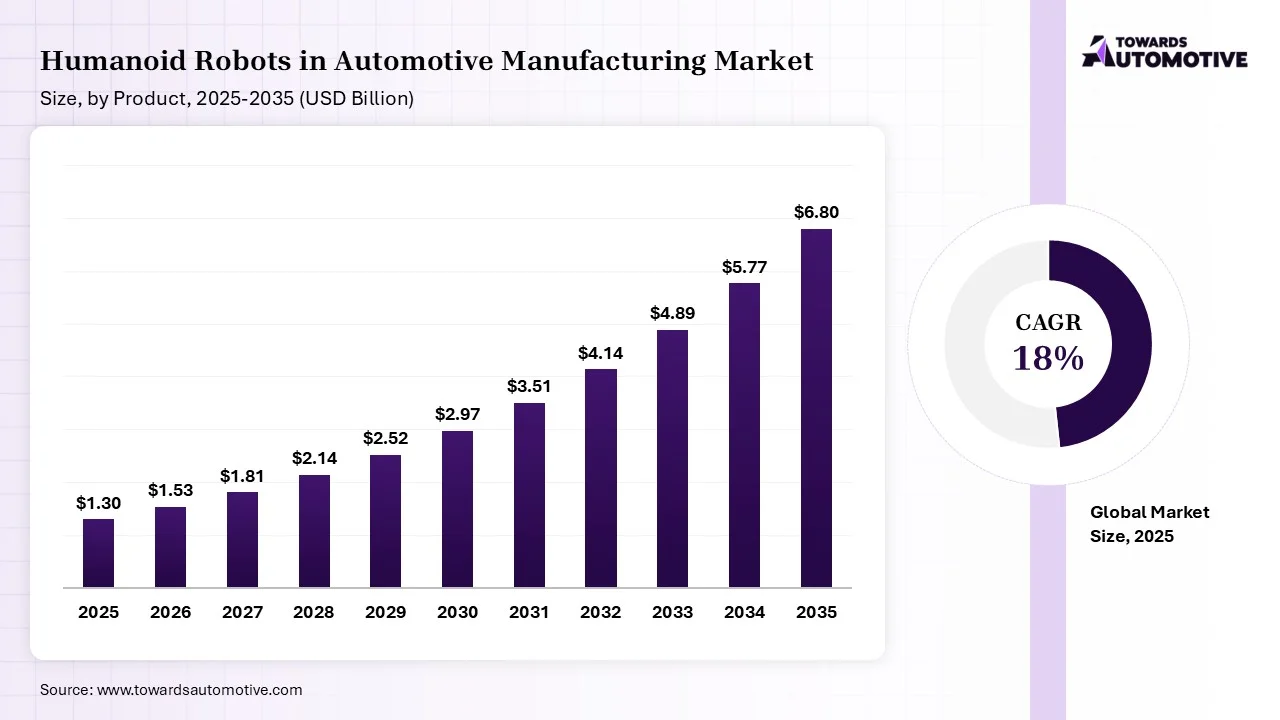
Humanoid Robots in Automotive Manufacturing Market Size 2025 to 2035

Key Takeaways

  • Asia Pacific dominated the market in 2025 and is expected to grow at the fastest rate in the coming years.
  • North America is expected to grow at a significant CAGR in the market during the forecast period.
  • By component, the hardware segment held a dominant position in the market in 2025.
  • By component, the software segment is expected to grow at the fastest CAGR in the market during the forecast period.
  • By motion type, the wheel-driven humanoid robots segment held a dominant position in the market in 2025.
  • By motion type, the biped humanoid robots segment is expected to grow at the fastest CAGR in the market during the forecast period.
  • By application, the assembly and component installation segment held a dominant share in the market in 2025.
  • By application, the quality inspection and testing segment is expected to grow at the fastest CAGR in the market during the forecast period.
  • By end user, the automotive OEMs (vehicle manufacturers) segment held a major share of the market in 2025.
  • By end user, the automotive logistics and warehouses segment is expected to grow at the fastest CAGR in the market during the forecast period.

Market Overview

Humanoid robots are designed to carry out human-like tasks such as component installation, material handling, assembly, and inspection on automotive production lines. The humanoid robots in automotive manufacturing market is rapidly growing. It is a key segment within the wider industrial robotics and smart manufacturing ecosystem. Rising labor shortages, the necessity for flexible automation, and the increasing complexity of electric vehicle (EV) manufacturing are driving the market. As these robots can work in human-designed factory environments, automotive OEMs are among the first adopters, accounting for the largest share of humanoid robotics demand. Commercialization across automotive facilities worldwide is growing due to investments, pilot deployments, and AI-driven robotics advancements.

How AI is Influencing the Humanoid Robots in Automotive Manufacturing Market?

AI is significantly transforming the humanoid robots in automotive manufacturing market. Capabilities of AI, such as computer vision, machine learning and real-time data analytics, enable humanoid robots to recognize objects, navigate factory floors and collaborate with human workers. AI enables robots to complete complex, adaptive tasks with greater precision and efficiency. The use of AI enhances production flexibility, reduces errors and enables predictive maintenance. AI-driven humanoid robots are attractive, crucial tools for improving productivity and operational efficiency, with automotive manufacturers increasingly adopting smart factories and Industry 4.0 technologies.

  • The rising shift toward flexible and smart manufacturing is driving the use of humanoid robots in human-designed environments to perform various tasks, making them adaptable for flexible automotive production lines.
  • Humanoid robots are increasingly integrated with AI, advanced learning algorithms, and computer vision technologies. This integration enables recognition of objects, learning from real-time data, and performing complex manufacturing tasks.
  • Automotive manufacturers are highly deploying robots on production lines for tasks such as component handling, assembly, and logistics.
  • To reduce reliance on manual labor and rising labor shortages, manufacturers are adopting humanoid robots, which can operate continuously and help maintain productivity in automotive factories.
  • Increasing R&D activities, rising investments in humanoid robotics, and partnerships between technology and robotics companies are accelerating the market growth.

Segment Insights

Component Insights

How Did the Hardware Segment Lead the Humanoid Robots in Automotive Manufacturing Market?

The hardware segment dominated the market with a major share in 2025. This is because hardware solutions have been instrumental in driving the adoption of humanoid robots in automotive manufacturing by providing the necessary physical components to enable complex, precise tasks. Key components such as advanced sensors, actuators, and flexible joints allow robots to perform intricate assembly, welding, and quality control with human-like dexterity and precision. These hardware advancements have led to improved efficiency, reduced downtime, and enhanced automation capabilities, positioning humanoid robots as essential tools in modern automotive production lines.

The software segment is expected to grow at the fastest CAGR in the market during the forecast period. Automotive industries are relying on advanced intelligent systems for various production procedures. AI-assisted vision systems and motion-planning software help robots to adapt to different vehicle models.

Motion Type Insights

What Made Wheel-Driven Humanoid Robots the Dominant Segment in the Market?

The wheel-driven humanoid robots segment held a dominant position in the market in 2025. Since humanoid robots are involved in transporting automotive components, supplying materials to assembly lines, and helping with logistic operations, the wheel-driven humanoid robots are widely adopted by the manufacturers. For fast and stable movement of robots, automotive plants are developed with large, smooth production floors and structured assembly lines. These robots enable lower energy consumption, better stability, cost-effectiveness, and ease of control.

The biped humanoid robots segment is expected to grow at the fastest CAGR in the market during the forecast period. This is because these robots can walk, climb, and access narrow pathways easily. These capabilities of humanoid robots are crucial in automotive manufacturing.

Application Insights

How Did the Assembly and Component Installation Segment Dominate the Market?

The assembly and component installation segment dominated the humanoid robots in automotive manufacturing market in 2025 due to its critical role in automating high-precision, repetitive tasks that are essential to vehicle production. Humanoid robots equipped with advanced sensors and actuators can seamlessly handle complex assembly processes, such as installing engine parts, wiring, and interior components, with high accuracy and speed. This automation reduces human error, increases production efficiency, and allows manufacturers to meet high-demand targets while improving overall safety and consistency in the manufacturing process.

The quality inspection and testing segment is expected to grow at the fastest CAGR in the market during the forecast period due to the increasing demand for precision, consistency, and automation in ensuring product quality. Humanoid robots equipped with advanced sensors and AI algorithms can perform highly detailed inspections at every stage of production, identifying defects or inconsistencies with greater accuracy than human workers. This capability not only improves the overall quality of automotive components.

End User Insights

How Did the Automotive OEMs Segment Dominate the Humanoid Robots in Automotive Manufacturing Market?

The automotive OEMs (vehicle manufacturers) segment held a dominant position in the market in 2025. Automotive OEMs adopt humanoid robots into large-scale production facilities that usually require high levels of automation to maintain efficiency, precision, and production speed. Integration of humanoid robots with assembly lines supports tasks such as component installation, material handling, and production efficiency.

The automotive logistics and warehouses segment is expected to grow at the fastest CAGR in the market during the forecast period. Humanoid robots are deployed for picking, sorting, transporting, and organizing components within warehouses to meet the increasing need for efficient material handling and inventory management.

Regional Insights

What Makes Asia Pacific the Leading Region in the Humanoid Robots in Automotive Manufacturing Market?

Asia Pacific dominated the market in 2025 and is expected to grow at the fastest rate throughout the forecast period. This is because the region boasts a strong automotive production base, with leading manufacturers like Toyota Motor Corporation and Hyundai Motor Corporation heavily automating their manufacturing processes through the adoption of humanoid robots. Additionally, increasing investments in advanced robotics technologies are fueling market growth, while government support for smart manufacturing, large-scale electronics production, and industrial automation is accelerating the widespread adoption of humanoid robots in automotive manufacturing.

China’s Humanoid Robots in Automotive Manufacturing Market Analysis

China's market is witnessing rapid expansion as the country increasingly adopts highly automated and advanced robotics in the automotive manufacturing sector. Leading Chinese companies, such as AgiBot and Unitree Robotics, are supplying humanoid robots to the automotive industry. Additionally, the country’s automakers, including XPeng, are actively investing in humanoid robotics to support their intelligent manufacturing strategies.

What Makes North America a Significantly Growing Region in the Market?

North America is expected to grow at a significant CAGR in the market during the forecast period. The region has a strong technological innovation background, with the adoption of automation in the automotive industry. The region hosts major automotive players and technology companies, which are heavily investing in humanoid robots for tasks like material handling, assembly support, and logistics. Further rapid expansion of EV manufacturing and increasing labor shortages are accelerating the market.

U.S. Humanoid Robots in Automotive Manufacturing Market Analysis

The U.S. is the major contributor to the North American market. The country hosts leading robotics developers such as Tesla, Boston Dynamics, and Figure AI. These innovative robots are being highly adopted by the U.S. automotive manufacturers to increase production efficiency. The country has a strong technological innovation, large-scale automotive production, and increasing investments in AI-powered robotics.

Top Companies in the Humanoid Robots in Automotive Manufacturing Market

  • BMW Group
  • Mercedes-Benz Group
  • Hyundai Motor Company
  • Tesla
  • Toyota Motor Corporation
  • Xiaomi
  • Figure AI
  • Boston Dynamics
  • Unitree Robotics
  • AgiBot
  • Kawasaki Heavy Industries

Recent Developments

  • In March 2026, Xiaomi, a Chinese technology and EV company, began testing its CyberOne Humanoid Robots operating as interns on the production line at an electric vehicle factory in Beijing, reportedly completing over 90% of assigned tasks during trial runs, signifying their potential for assisting with repetitive manufacturing activities.
  • In March 2026, BMW Group launched humanoid robots in Germany. It is introduced as a pilot program integrating physical AI into manufacturing, assisting in tasks such as component handling and supporting production operations on the assembly line.

Humanoid Robots in Automotive Manufacturing Market Segments Covered in the Report

By Component

  • Hardware (sensors, actuators, control systems, robot body)
  • Software (AI, machine learning, vision systems, navigation)
  • Services (integration, maintenance, support)

By Motion Type

  • Wheel-driven humanoid robots
  • Biped humanoid robots

By Application

  • Material handling and logistics
  • Assembly and component installation
  • Welding and fastening
  • Painting and coating
  • Quality inspection and testing
  • Machine tending

By End User

  • Automotive OEMs (vehicle manufacturers)
  • Automotive component suppliers
  • Automotive logistics and warehouses

By Region

  • North America
    • U.S.
    • Canada
    • Mexico
    • Rest of North America
  • South America:
    • Brazil
    • Argentina
    • Rest of South America
  • Europe:
    • Western Europe
    • Germany
    • Italy
    • France
    • Netherlands
    • Spain
    • Portugal
    • Belgium
    • Ireland
    • UK
    • Iceland
    • Switzerland
    • Poland
    • Rest of Western Europe
  • Eastern Europe
    • Austria
    • Russia & Belarus
    • Türkiye
    • Albania
    • Rest of Eastern Europe
  • Asia Pacific:
    • China
    • Taiwan
    • India
    • Japan
    • Australia and New Zealand
    • ASEAN Countries (Singapore, Malaysia)
    • South Korea
    • Rest of APAC
  • MEA
    • GCC Countries
      • Saudi Arabia
      • United Arab Emirates (UAE)
      • Qatar
      • Kuwait
      • Oman
      • Bahrain
    • South Africa
    • Egypt
    • Rest of MEA

Find Out:

  • How are production and deployment trends of humanoid robots evolving across automotive OEMs and supply chain operations globally?
  • What do regional adoption patterns and market share data reveal about the dominance of Asia Pacific and growth potential in North America?
  • How are manufacturers optimizing robot uptime, reducing downtime, and improving productivity in automotive production environments?
  • What supply chain challenges exist in sourcing key hardware components such as sensors, actuators, and AI systems, including lead times and inventory management?
  • How do robot specifications (wheel-driven vs. biped, hardware vs. software capabilities) influence performance across assembly, logistics, and inspection tasks?
  • How are logistics, integration, and deployment timelines impacting the scalability of humanoid robots across automotive facilities?
  • How is demand for flexible automation, EV manufacturing, and labor substitution shaping adoption trends across regions and applications?
  • What are the key financial metrics, including cost per robot, ROI, and operational savings, influencing investment decisions in humanoid robotics?
  • How are regulatory standards, workplace safety norms, and industrial automation policies affecting deployment strategies in automotive manufacturing?
  • What competitive strategies, partnerships, and AI-driven innovations are leading companies adopting to strengthen their position in this market?

Tags

Share With : linkedin twitter facebook
  • Insight Code: 1876
  • No. of Pages: 150
  • Format: PDF/PPT/Excel
  • Last Updated: 23 March 2026
  • Report Covered: Revenue + Volume
  • Historical Year: 2021-2023
  • Base Year: 2024
  • Estimated Years: 2025-2034

Meet the Team

Ajit Bansod is a skilled and research-driven analyst at Towards Automotive, with over 3 years of experience specializing in the intersection of automotive innovation and intelligent communication technologies.

Learn more about Ajit Bansod

Aditi Shivarkar, with 14+ years of experience in automotive market research, specializes in tracking trends across vehicle technologies, mobility solutions, and materials innovation. She delivers accurate, actionable insights that drive excellence in the automotive sector—fueling strategies around electrification, sustainability, and advanced manufacturing.

Learn more about Aditi Shivarkar

FAQ's

Humanoid robots are used for tasks such as component installation, material handling, assembly, welding, inspection, and logistics operations within automotive production lines.

Asia Pacific dominates the market due to its strong automotive production base and high adoption of automation, while North America is expected to grow at a significant rate.

Ready to talk to a Towards Automotive consultant?

We offer automotive expertise for market projections and customizable research, adaptable to diverse strategic approaches.

Contact Us