
.webp) Download Sample
Download Sample
 Schedule a Meeting
.webp) Download Sample
Download Sample
 USA : +1 8044 419344
 sales@towardsautomotive.com
March 2026




The twin-cylinder bike market is projected to grow from USD 38.47 billion in 2026 to USD 63.37 billion by 2035, registering a CAGR of 5.7% during the forecast period. The report provides detailed coverage of market size, along with segment-wise data by engine capacity, bike type, and application. It includes regional analysis across North America, Europe, Asia-Pacific, and other regions, along with insights into key companies, competitive landscape, value chain analysis, and trade data, offering a comprehensive view of manufacturers and suppliers operating in the market.
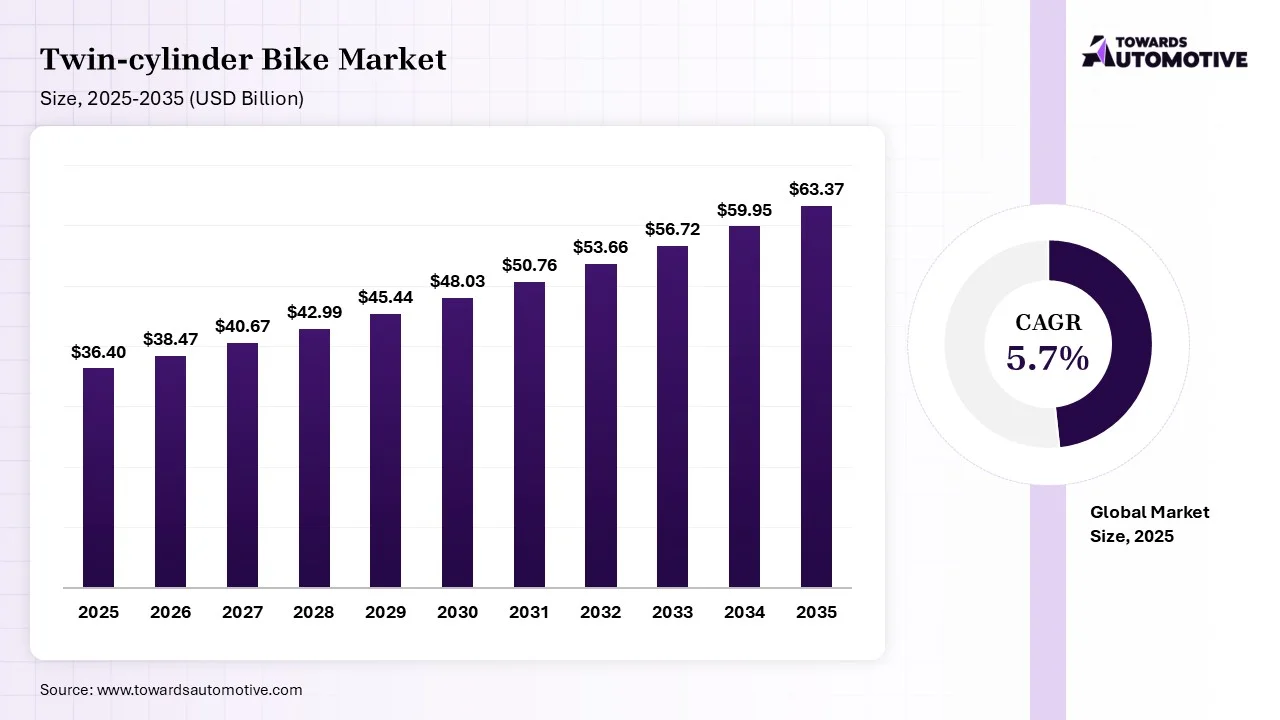
The twin-cylinder bikes have engines with two cylinders. These are designed to balance power, efficiency, and smooth performance. Such bikes are suitable for commuting, touring, and sport riding. The twin-cylinder market is experiencing steady growth driven by increasing demand for high-performance bikes, rapid urbanization, stricter emission standards, and technological progress. Rising disposable incomes and a shift toward premium biking experiences also boost the market. Additionally, advancements like fuel injection systems and improved safety features are key growth drivers.
AI is transforming the twin-cylinder bike market. It improves performance, safety, and user experience. Advanced rider-assistance features like adaptive cruise control and traction control depend on AI models. AI algorithms support predictive maintenance to ensure safety and reliability. AI-driven engine management systems optimize fuel injection, ignition timing, and throttle response for better efficiency and smoother rides. Manufacturers are also using AI in design and production processes to boost engine efficiency, cut emissions, and speed up innovation in twin-cylinder bikes. Additionally, AI allows for real-time diagnostics and personalized riding modes based on user behavior.
This stage includes sourcing aluminum alloys, steel, rubber, and electronic components such as crankshafts, pistons, and cylinders through a global supplier network and supply chains.
This stage involves material testing, dimensional inspection, functional testing, and compatibility validation using tools like CMM machines, spectroscopy, simulation testing, and real-world performance testing.
Distribution of fully developed bikes via OEM channels and dealers' network, through global logistics, regional warehouses, and dealership ecosystems.
Through authorized service centers, spare part distributors, and online platforms, maintenance services are offered. It includes replacement parts (pistons, gaskets, filters), servicing, and upgrades throughout the bike's post-sale lifecycle.
The below 400cc segment led the market with the largest share in 2025. This is because these bikes are affordable, making them accessible to a larger population, especially in price-sensitive markets. They offer a balance between performance and efficiency. They deliver smoother power to riders and better handling, without high fuel consumption or maintenance costs. The growing demand for premium bikes, consumers' increasing preferences, and affordability are key factors for segment growth. Furthermore, lower engine capacities are favored by regulatory and licensing norms, boosting adoption.
The 400cc-800cc segment is expected to grow at the fastest CAGR in the market during the forecast period. These engines offer numerous benefits, including suitability for city riding, highway trips, and adventure touring, making them attractive to a wide range of consumers. They blend affordability with high performance. Moreover, growing consumer interest in adventure and touring bikes increases demand for better torque and long-distance comfort. Additionally, rising disposable incomes and emerging market trends encourage riders to invest in this segment. Manufacturers are adding technological innovations to meet consumer demands, boosting segment growth.
The parallel twin segment dominated the market in 2025. This engine’s architecture is very simple and cost-effective to manufacture, which enables manufacturers to price bikes more competitively. They provide a compact and lightweight design, supporting better chassis integration, improved handling, and suitability across various bike categories, especially sports and adventure models. Parallel twins are easy to tune for lower emissions and allow performance maintenance with fuel efficiency and compliance with emission norms. They offer smooth power delivery, reduced vibration, and enhanced rider comfort and balance. They drive scalability, strengthening their dominance in the market through heavy adoption by OEMs to build multiple models on a single engine base.
The V-shaped segment is expected to grow at the fastest CAGR in the market during the forecast period. It offers higher torque and distinctive power delivery, making it ideal for cruiser, touring, and performance-oriented bikes. Aspirational buyers are influenced by a manufacturer's brand presence, expanding their V-twin portfolios. Since they provide comfort and stability, increased interest in this segment is driven by long-distance touring and leisure riding. Furthermore, the rising demand for premium and lifestyle bikes is boosting their popularity.
Asia Pacific led the twin-cylinder bike market in 2025, driven by a combination of economic, demographic, and industry-specific factors. The region benefits from a large and expanding consumer base in countries such as India, China, and Indonesia, where motorcycles remain a primary mode of transportation. Demand spans both commuter and premium segments, with a noticeable shift toward mid-range, premium, adventure, and touring bikes.
Rising disposable incomes and rapid urbanization are encouraging consumers to upgrade from single-cylinder to twin-cylinder models, further boosting market growth. Additionally, the presence of major manufacturers and well-established production hubs supports cost-efficient manufacturing and enhances market accessibility. Favorable government policies, improving infrastructure, and an extensive dealer network also contribute to the market’s expansion by ensuring broad availability across both urban and semi-urban areas.
China Twin-Cylinder Bike Market
The twin-cylinder bike market in China is witnessing rapid growth due to rising demand for premium and mid-range bikes. The expanding domestic manufacturing base, with domestic companies producing affordable twin-cylinder bikes and components, is one of the growth factors. With the rising disposable incomes and lifestyle upgrades, consumers are moving beyond traveler bikes toward higher-performance twin-cylinder models.
International brands are investing in localized production through partnerships. Furthermore, the growing interest of the young riders in adventure touring and leisure riding supports the market growth. Government initiatives, such as improvements in road infrastructure, are boosting the adoption of twin-cylinder bikes. Evolving regulatory frameworks and strict urban regulations demand advanced emission-free twin-cylinder bikes.
North America is expected to grow at a significant CAGR in the market during the forecast period. The region is characterized by a strong culture of leisure riding, touring, and motorcycling as a lifestyle, which drives demand for powerful and comfortable twin-cylinder bikes. Consumers in this market show a clear preference for mid-range, high-capacity motorcycles suited for long-distance travel. The increasing popularity of adventure and cruiser segments is further accelerating adoption, as twin-cylinder engines offer enhanced torque, stability, and performance. Rising disposable incomes also enable consumers to invest in premium motorcycles equipped with advanced features and technologies.
U.S. Twin-Cylinder Bike Market
The U.S. twin-cylinder bike market is driven by the rising demand for premium, cruiser, and touring bikes. The country reflects a strong consumer preference for performance-oriented bike models, with a significant share of sport, touring, and cruiser bikes powered with twin-cylinder engines. The consumers are encouraged by heavyweight and performance twin-cylinder bikes due to their superior torque and smooth riding experience. The country has a mature bike market, with revenues usually remaining high. Additionally, the presence of strong domestic and global manufacturers boosts production. The presence of extensive dealerships and aftermarket networks enhances product availability and service support.
By Application
By Types
By Region



March 2026
October 2025
October 2025
September 2025
We offer automotive expertise for market projections and customizable research, adaptable to diverse strategic approaches.
Contact Us