



The panoramic head-up displays (HUD) market is projected to grow from USD 1.73 billion in 2026 to USD 6.34 billion by 2035, registering a CAGR of 15% during the forecast period. The report provides comprehensive coverage of market size along with detailed segment-wise data by component, vehicle type, and display technology. It includes regional analysis across North America, Europe, Asia-Pacific, and other regions, along with insights on production, consumption, and demand patterns. The study also covers key companies, competitive analysis, value chain assessment, and detailed trade data including import-export trends, as well as manufacturer and supplier landscape to provide a complete market overview.
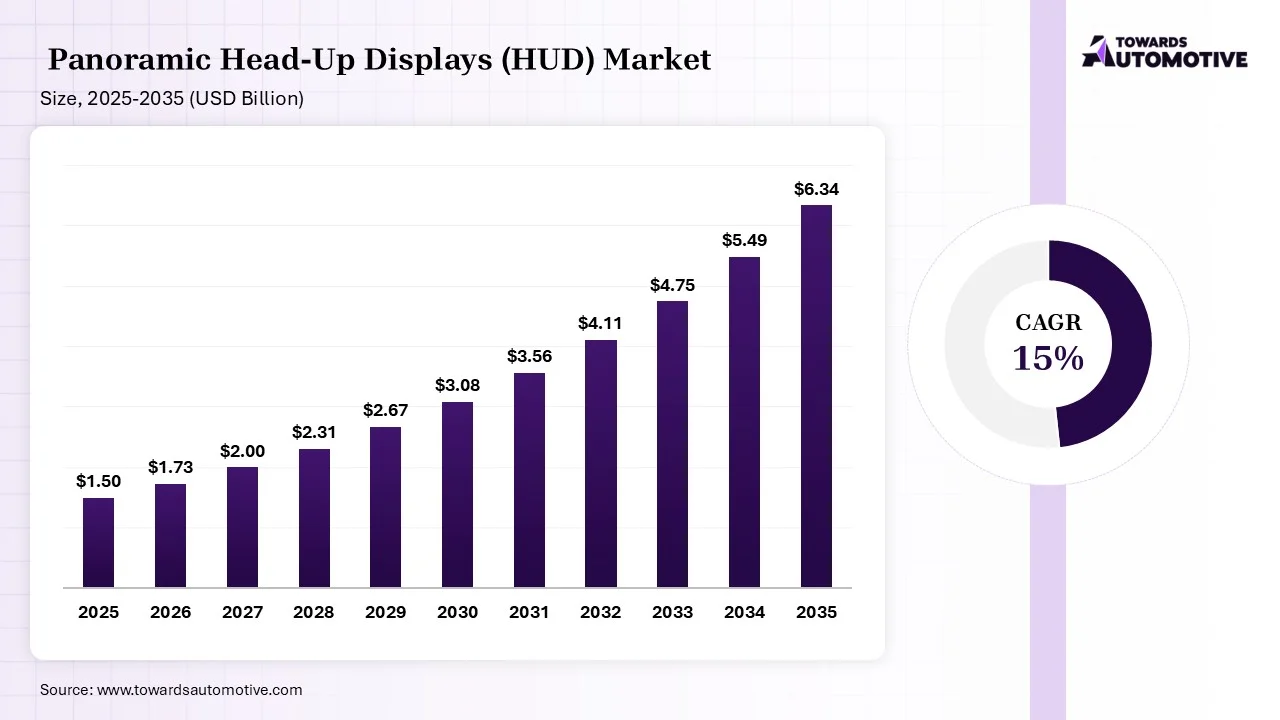
Panoramic head-up displays (HUDs) are advanced in-vehicle display systems that display driving information directly on a large windshield. The panoramic head-up displays (HUD) market is evolving rapidly as automotive manufacturers are adopting advanced digital cockpit technologies to improve driver safety. The integration of advanced driver-assistance systems (ADAS), augmented reality navigation, and connected vehicle features is accelerating adoption. Expanding demand for immersive in-vehicle displays and the expansion of HUD technology beyond premium vehicles are anticipated to drive market growth.
AI is significantly transforming the market. AI-powered cockpits enable smarter, background-conscious visual information for drivers. It supports augmented reality overlays that highlight lanes, pedestrians, or obstacles on the windshield. AI-driven cockpits process data from sensors, cameras, and navigation systems to display relevant alerts, navigation cues, and safety warnings in real-time. AI-driven HUDs are gaining rapid adoption, with the rising demand for connected and autonomous vehicles for a more impressive in-vehicle experience.
This stage includes sourcing of optical glass, holographic films, projection optics, microLED/LCoS displays, semiconductor chips, and anti-reflective coatings.
This includes optical alignment testing, brightness and visibility validation, environmental stress tests, software validation, and regulatory certification, such as IATF 16949, ISO standards, to ensure regulatory compliance.
HUD models, integrated cockpit display systems, and AR-HUD platforms are distributed to automotive manufacturers, and HUD suppliers collaborate with automotive OEMs through Tier-1 supply deals.
The windshield panoramic HUD segment held a dominant position in the market in 2025. These HUDs project the information across a large portion of the windshield, enabling drivers to see navigation, speed, and warnings without shifting focus away from the road. It supports AR-HUD features that enable real-time overlays such as lane guidance, obstacle alerts and navigation. Rising adoption of luxury and electric vehicles is further driving the segment growth. These HUDs provide better driver safety and situational awareness by reducing distractions. Advancements in display technologies have accelerated the adoption.
The combiner panoramic HUD segment is expected to grow at a significant CAGR during the forecast period. Unlike windshield HUDs, combiner systems use a separate display screen, making them more cost-effective and easier to integrate into a variety of vehicles. This flexibility is driving adoption beyond premium models, with compact and mass-market vehicles increasingly incorporating combiner HUDs to enhance driver information, navigation, and safety features.
The passenger car segment dominated the market in 2025 due to the increased vehicle ownership. Since HUDs help display safety alerts, navigation guidance, and driving information directly in the driver’s line of vision, passenger vehicles are increasingly adopting HUDs. To improve user experience and differentiate vehicle models, many premium vehicles and electric vehicles are adopting panoramic HUDs.
The commercial vehicle segment is expected to grow at the fastest rate in the coming years. Since commercial vehicles such as trucks and buses operate for longer hours and over long distances, the integration of panoramic HUDs is increasing to ensure driver safety. For better operational efficiency, fleet management systems adopt digital cockpit technologies. Further, growing adoption of ADAS in commercial vehicles is increasing demand. With the rapid expansion of logistics industries, demand for technologies that enhance driver awareness is increasing.
The laser segment held a dominant position in the market in 2025. Laser-based projection systems provide higher brightness and visibility even in daylight conditions. It enables sharp, high-resolution visuals with longer operational life and less consumption of power, making them suitable for continuous automotive use. Further, it improves augmented reality capabilities and enables dynamic overlays. Increasing integration in premium vehicles to deliver immersive digital cockpit experiences is accelerating segment growth.
The LED segment is expected to grow at the fastest CAGR in the market during the forecast period. LED-based HUD systems are manufactured at a lower cost, making them more affordable for integration in mass-market vehicles. It supports compact and energy-efficient design. Further continuous technological advancements, such as improved LED brightness, resolution, and durability, are accelerating the segment growth. Growing demand for digital cockpit systems anticipates the use of LED-based HUD technology in new vehicles.
The entertainment segment held a dominant position in the market in 2025, driven by increasing demand for integrated infotainment features such as media playback, navigation visuals, and smartphone connectivity. Consumers are seeking an enhanced in-vehicle user experience, with entertainment-related information projected directly within their line of sight. These systems are often part of smart cockpit integrations, combining infotainment, navigation, and vehicle data into a unified interface. The growing popularity of premium vehicle features, including customizable displays and interactive infotainment, is further accelerating the growth of this segment.
The navigation segment is expected to grow at the fastest CAGR in the market during the forecast period. This is mainly due to the rising adoption of real-time navigation systems for route optimization and traffic updates, as well as the development of augmented reality (AR) navigation technologies. Integration with connected vehicle platforms, including cloud services, traffic data, and GPS networks, further enhances the functionality of HUD-based navigation.
Asia Pacific led the panoramic head-up displays (HUD) market in 2025 and is expected to sustain its leadership in the coming years, owing to rapid growth in automotive production, rising adoption of electric and connected vehicles, and strong consumer demand for advanced in-vehicle technologies. Countries such as China, Japan, South Korea, and India are investing heavily in smart mobility solutions, ADAS integration, and next-generation cockpit systems, which drive demand for windshield, combiner, and AR HUDs. Additionally, the presence of major automotive manufacturers and suppliers, coupled with favorable government policies promoting automotive innovation and EV adoption, has accelerated market growth.
China Panoramic Head-Up Displays (HUD) Market Analysis
China leads the market within Asia Pacific due to its position as the world’s largest automotive manufacturing hub, with rapidly growing production and sales of passenger cars, commercial vehicles, and electric vehicles. The country has a strong adoption of advanced in-vehicle technologies, including HUDs, AR displays, and smart cockpit systems, driven by consumer demand for enhanced safety, navigation, and infotainment features. Additionally, Chinese automakers and technology suppliers are heavily investing in connected vehicles, ADAS, and electric mobility, while government policies supporting EV adoption and automotive innovation further accelerate the deployment of panoramic HUDs.
Europe is expected to grow at a significant CAGR in the market during the forecast period. Europe is a hub for leading luxury vehicle manufacturing companies that are widely adopting advanced cockpit technologies. Increasing adoption of advanced driver-assistance systems (ADAS), rapid growth of electric vehicles, increasing focus on automotive innovation and research and development, and government regulations supporting vehicle safety are driving the region’s market. Strict safety regulations are accelerating the demand for HUD technologies that enhance driver awareness. European automakers are heavily investing in developing next-generation automotive display technologies. Regulatory guidelines are encouraging the adoption of ADAS to reduce road accidents by reducing driver distraction.
Germany Panoramic Head-Up Displays (HUD) Market Analysis
The German panoramic head-up displays (HUD) market is evolving rapidly due to the country’s strong automotive industry and high adoption of advanced in-vehicle display technologies. The country is home to leading automakers such as BMW, Mercedes-Benz, and Audi, which integrate panoramic HUD technology in premium vehicles. Germany is a major hub for augmented reality head-up display innovation. Growing electric vehicle models in the country, integrated with HUD systems, are further accelerating market growth. Germany has a strong automotive R&D ecosystem with heavy investments in innovations.
By Product Type
By Vehicle Type
By Technology
By Application
By Region



We offer automotive expertise for market projections and customizable research, adaptable to diverse strategic approaches.
Contact Us
.webp) Download Sample
Download Sample
 Schedule a Meeting
.webp) Download Sample
Download Sample
 USA : +1 8044 419344
 sales@towardsautomotive.com